
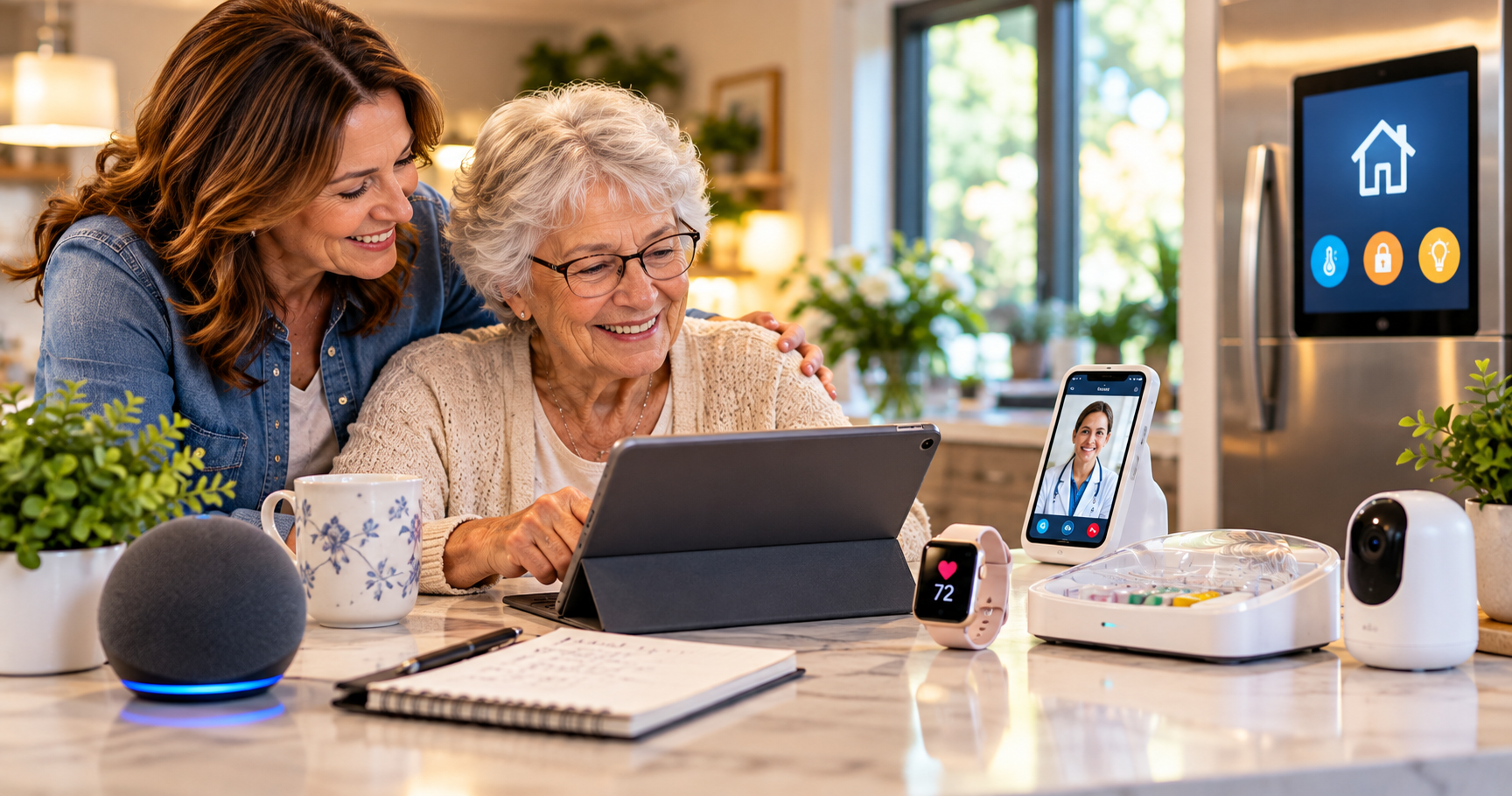
It's a quiet Sunday night. You've called twice, and Mom hasn't picked up. Chances are she's in the garden or the phone is in the other room. But the what-ifs are loud, and if you're a caregiver, you know exactly how loud. If you live two hours away (or two states), they get louder still.
Here's the good news: the gap between "I hope she's okay" and "I know she's okay" is shrinking. Voice assistants like Alexa and Google Assistant, wearables, motion and fall sensors, video doorbells, medication reminders and simple video calling can all help a parent stay safe, independent and connected at home. Here's the honest part: the technology isn't the hard part. The questions are.
Is a camera caring, or is it spying? Where's the line between safety and dignity? Will she actually use it? Who gets the alerts at 3 a.m.? What can I do from far away when I can't be there in person? Those are the questions at the center of this month's program, and nobody should have to answer them alone.
Join two presenters for a practical, honest conversation (with real devices and a few live demos) about what's out there, what's worth it and what's just noise. You'll hear how families are choosing technology WITH their parents instead of for them, how to make everyday devices easier to see, hear and use, and how to stay close when you can't drop by. And yes, we'll cover the low-tech heroes too: the shower bench, the grabber and the humble pill organizer that quietly do their jobs every day.
The enemy here isn't Mom and it isn't the technology. It's the distance, the gap and the 3 a.m. what-if. With Valentine's Day just five days away, consider this a love language for the long-distance caregiver: showing up when you can't be there.
What you'll walk away with
• A plain-English tour of home safety technology: voice assistants, fall and movement monitoring, cameras, sensors and medication tools
• A short list of questions to ask before you buy anything, so the technology fits your parent's real life and respects their independence
• Practical ways to stay connected and in the loop when you live far away, plus how to decide whether your parent may need more help at home